

Program Overview
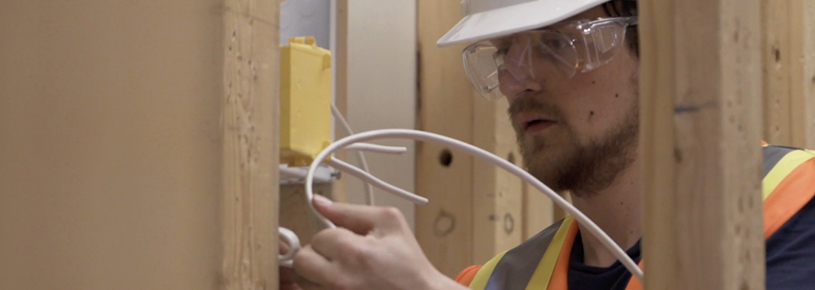
Construction Electricians work under the supervision of a licensed electrician which allows the new electrical worker to gain experience, skills, and confidence in the newly chosen trade to work on a variety of electrical work. Their tasks vary from day to day and include many types of initial electrical preparation, site configuration, use of working drawings, material handling, wiring with different types of wire, and finishing skills.
There is an increasing demand for Skilled Trades Workers for the construction industry. This program provides students with the fundamentals of working within the construction industry as an apprentice electrician and at the same time increasing student knowledge to the key principles of working safely with electricity in the construction industry. Construction concepts, processes, tools, equipment and working environments are explored. Students will be presented with problems that will require them to apply their trade skills for, problem solving, and critical thinking.
Students will learn to use a variety of power tools, hand tools, and portable equipment while examining industry practices ensuring that safe quality work has been completed. Students can expect to be presented with a robust learning and assessment environment using real-world examples, not only designed to teach electrical methodologies and practice, but also communications skills that facilitate interpersonal collaboration and cooperation.
Learning Objectives
Upon completion of this program, learners will be able to:
- Understand basic trade mathematics.
- Use interpersonal communication.
- Use fire safety procedures.
- Demonstrate and use safe work practices.
- Use the correct Personal Protective Equipment.
- Demonstrate safety practices and maintenance of hand and power tools.
- Perform jobsite preparation.
- Use portable tools and mobile equipment.
- Install electrical components.
- Use rigging and hoisting equipment.
- Perform electrical rough-in.
- Use document and blueprint reading skills.
- Use problem solving skills.
- Use electrical codes.
- Perform quality workmanship for electrical tasks.
- Assemble and configure scaffolding.
- Work collaboratively with coworkers.
Why Study at Sprott Shaw?
- Get Started Sooner
Our BC Trades Programs are offered on a monthly intake system that keeps the waiting to a minimum. That means you can get into the classroom and then out on the job site much faster than at other trade schools in BC. - Unmatched Hands-On Training
Not only does our trade school provide you with modern equipment that you’ll use every day on the job, but our deliberately convenient class sizes also allow instructors to work with students on a first-name basis. - Learn The Skills Employers Need
We don’t just teach the bare-minimum SkilledTradesBC standard, our curriculum also focuses on teaching the in-demand skillsets that employers are desperately seeking across the Lower Mainland and BC. - Access To The Ultimate Electrical Learning Lab
Our electrical lab makes Sprott Shaw one of the largest and best-equipped trade schools in BC. Not only is there more equipment and space to work, but there is also a steel-studded practice wall, concrete slab, pulling stations, fire alarm wiring wall, and more! - Learn From Experienced Industry Experts
Sprott Shaw instructors aren’t just teachers, they are practicing industry veterans who know how to equip students with the skills they need to successfully launch their new careers.
Where Are Sprott Shaw Graduates Working?
Our Trades and Design graduates can be found working throughout the province. Numerous electrician services have hired our graduates including Vancity Electric, Red Seal Electric, Nightingale Electric, and more.
Click below to learn more about where our graduates are currently working. Please note that these lists do not cover every single business that has hired a Sprott Shaw graduate, but they do provide a good representation of the sort of industries that Sprott Shaw graduates are working in

Success Story
- “I met so many friendly people! The teachers were amazing and helped me understand some things that I didn’t quite get at first. They were flexible and generous enough to help after school hours, which I was grateful for.” – Naweed A.


Virtual Tour of the Trades Campus


Program Details
Admission Requirements:
- Grade 12 graduation or equivalent (General Education Development, Adult Basic Education) or mature student status (age 19 and one year out of school). All transcripts must be “true certified copies” or originals.
- Applicants must successfully complete the admissions interview and English language entrance requirements and have a minimum score of 20/40 in the Math Assessment.
- For more information on English Language requirements and equivalencies, please click here.
LANGUAGE PROFICIENCY POLICY:
All programs at Sprott Shaw College (SSC) are conducted in English, making proficiency in the English language a requirement for enrollment.
The required proficiency can be demonstrated through 1) completion of secondary or post-secondary education where English is the language of instruction and is also one of the country’s official languages, or 2) An approved English Language Assessment, 3) Graduation from Sprott Shaw Language College’s (SSLC) EPE: English for Post-Secondary Education program, or 4) For mature (≥ 19 years) students who are facing barriers and cannot access their educational records or provide sufficient evidence of secondary or post-secondary education.
SSC programs that have a higher English language level, require additional years of secondary or post-secondary education where English is the language of instruction, or where language proficiency is to be otherwise demonstrated, are identified within the relevant program outlines.
For all other SSC programs, English language proficiency is demonstrated by:
1. Education
a) Secondary Education
Evidence of Successful Fulltime Secondary Education Completion*, where English is one of the principle languages of instruction:
i) Showing two (2) years, if all Grades successfully completed are 10, 11, or 12, or
ii) Showing three (3) years if the successful Grades are 8, 9, 10, 11, or 12
iii) Showing validation of both language of instruction and credential level is provided by WES, ICES or IQAS
OR
b) Post- Secondary Education
Evidence of 2 years of Fulltime Post-Secondary Education Completion*, where English is one of the principle languages of instruction. Language development courses (i.e. ELL courses) cannot be included in this calculation.
*This may be demonstrated by providing a high school transcript, completion of a BC Adult Graduation program, or providing validation of both language of instruction and credential level is provided by WES, ICES or IQAS.
Countries where English is the language of instruction:
American Samoa, Anguilla, Antigua and Barbuda, Australia, Bahamas, Barbados, Belize, Bermuda, Botswana, British Virgin Islands, Canada, Cayman Islands, Dominica, Falkland Islands, Fiji, Gambia, Ghana, Gibraltar, Grenada, Guam, Guyana, Ireland, Jamaica, Kenya, Lesotho, Liberia, Malta, Mauritius, Montserrat, New Zealand, Nigeria, Saint Helena, Saint Lucia, Saint Kitts and Nevis, Saint Vincent and the Grenadines, Seychelles, Sierra Leone, Singapore, South Africa, Tanzania, Trinidad & Tobago, Turks and Caicos Islands, Uganda, United Kingdom, United States, United States Virgin Islands, Zambia, & Zimbabwe.
OR
2. Assessment
By achieving a recognized standardized language test/assessment.
Approved English language assessment options:
· IELTS. International English Language Testing System (IELTS) Academic: Minimum overall score of 5.5.
· TOEFL. Test of English as a Foreign Language IBT: Minimum overall score of 46
· CAEL. Canadian Academic English Language Assessment. Minimum overall score of 40
· CELPIP. Canadian English Language Proficiency Index Program: Listening 6, Speaking 6, Reading 5 and Writing 5.
· DET. Duolingo English Test: Minimum overall score of 95
· PTE. Pearson Test of English Academic: Minimum overall score of 43
· Cambridge English Qualifications: Minimum overall score of 160 or “C”
· Cambridge Linguaskill: Minimum overall B2 level
· LanguageCert Academic: Minimum overall B2 level
· MET. The Michigan English Test: Minimum overall B2 level
· iTEP Academic: Minimum overall score of 3.5
· EIKEN: Minimum placement of Grade Pre-1
OR
3. SSLC EPE Graduation
Successful completion Sprott Shaw Language College’s (SSLC’s) English for Post-Secondary Education (EPE) Pathway, allowing for direct admission into higher education without further entrance testing. Documentation of the student’s graduation from the pathway program must be included in the student’s record.
OR
4. Accuplacer
For mature (≥ 19 years) students who are facing barriers and cannot access their educational records or provide sufficient evidence of secondary or post-secondary education.
Applicant must be 19 years or older at the start of the program and a Canadian citizen or permanent resident and provides attestation that they have completed at least three years of full-time secondary or post-secondary instruction in English in a country where English is one of the principal languages (please refer to Countries where English is the language of instruction).
Accuplacer English Assessment (Next Generation) and achieves the following minimum scores required:
· Reading: 230
· Writing: 230
· WritePlacer: 4
For more information on our English language program-specific requirements and English equivalencies please click here: Sprott Shaw College English Language Requirements and Equivalents
Math Entrance Requirements:
- Domestic students that can provide a Canadian transcript showing completion of Math 10, 11 or 12 (or equivalent) with a passing grade of ‘C’, will be exempt from having to write the Math Entrance Assessment
Certificate Requirements:
- 70% average upon successful completion of all courses and the required number of attested practicum hours. CPR, First Aid and WHMIS will be completed during the program.
The Sprott Shaw College final grade will account for 80% of the student’s overall mark for Electrical Foundations, with the Standardized Level Exam (SLE) accounting for the other 20%.
Other Requirements:
- FACPR First Aid / CPR (Comp/Inc)
- WHMIS WHMIS (Comp/Inc)
Students can expect to complete 1 – 3 hours of homework per day.
Contact Us Today!
Our advisors are happy to answer any questions.
Courses List
This 24 week Certificate program requires the student to complete the following courses.- This course provides learners with the necessary context of safe work practices through sharing a basic understanding of OHS regulations, WorksafeBC Standards, safety equipment, lifting, hazard control, lockout-tagout, using the proper Personal Protection Equipment, assembling, and using a harness for Fall Protection, and Fire Safety Procedures.
- This course offers learners the abilities to learn to apply the principles of electricity through circuit concepts, principles and analysis in classroom and laboratory activities. Students will use the concepts of calculating circuit values for, resistance, voltage, current, and power for electrical systems. Electrical drawings aid to perform the calculations and gain a comprehensive basic understanding of circuitry.
- This course delivers an essential understanding of magnetism for the student as electromagnetism is one of the fundamentals of science. Application of electromagnetism principles support the student learning of magnetic circuitry and benefits in solving the associated problems. Real world applications are discussed in class.
- This course delivers an essential window of understanding the characteristics of semiconductor materials used in electronics. Operating principles for applications using electronic circuitry are developed to understand DC circuits and the accompanying components that include diodes and bi-polar transistors. Electronics has become a universal component for LED lighting, controls, robots, and machines that surround our everyday lives. Application of electronic principles support the student learning of electronic circuitry and benefits in solving the associated problems with real world applications are integrated into the topic. This course provides students the opportunity to explore digital and analogue meter testing equipment along with their care and maintenance. Various types of meters are demonstrated then used on laboratory work to gain an in-depth understanding of these important industry tools.
- This course exposes the methodologies, components, and practices to describe, configure, assemble, install, test, and maintain communication and network structured cabling systems within different environments.
- Extra low voltage systems are introduced as a pathway to learnings in the electrical trade as to their usage in HVAC, lighting systems, security, surveillance systems, home automation and access control.
- This course will provide students with the conceptual and practical foundations for understanding how to read, scale, analyse and interpret Working Drawings, Specifications and User Manuals to find the information needed thereby gaining practical abilities from practice.
- This Canadian Electrical Code course provides students with a basic understanding of the regulations and standards applicable to electrical installations. Students learn the requirements to install single-phase three-wire distribution system service equipment, protective devices, principles and applications for grounding, bonding, and appropriate materials, including distribution centers, raceways, boxes, fittings, switches, cables, and receptacles.
- This course provides students the theory and application for working with motors, motor controls, motor starters, and using safe work procedures. Students use diagrams and create diagrams for laboratory work to operate three phase controls for switching relays, jogging circuits, reversing motor starters, including basic trouble shooting and testing practices.
- This Canadian Electrical Code course provides students with the required information for operation of LED and incandescent lighting, other lighting types, their controls, and the processes for maintenance. Lighting standards construction, installation, operation, and maintenance are explored. Further discussion surrounds identification, grades, rating, testing and installation of receptacles, switches, and a CEC course overview.
- This course is an electrical residential build that provides students with the necessary knowledge to design, plan, assemble, construct, and test a residential electrical installation configured according to present building and electrical codes.
- This course provides students with a comprehensive review of the Foundations Course learning practices with many assessments, questions, and examples to prepare for final evaluation.
- This course provides students with trades mathematical skills focused on a numeracy refresher, metric and imperial units of measurement, volume, area, perimeter, temperature, ratios, percentages, and solving various problems using formula applications to manipulate measurements with algebra. This allows a student to improve their abilities and gain confidence in mathematics as their practiced skills increase.
- The course also provides the foundations in trigonometry, which is used for electrical theory, power factor correction, transformer calculations, circuit layout, three phase analysis, pipe bending, and angular construction in the electrical trade.
- This introductory course provides learners with techniques for creating success in their studies and careers. The course emphasizes skills and strategies conducive to learning in a college atmosphere. Students will be oriented to the college facilities, policies and procedures, and the technology used at the college. Writing skills and the use of technology for assignments and presentations will be practiced. Specific strategies to enhance learning and the enjoyment of the college experience are explored. Introduction to the electrician profession and apprenticeship system is the common theme throughout this course.
- This course also provides students with the necessary interpersonal communication, study and learning skills, and mentoring facilitation for a worker to gain confidence in their chosen trade. Examples are imbedded throughout the course to complement the learning tasks and the apprentice system is discussed to aid the student in their trade career path while also identifying trade career resources.
- This course introduces students to the concepts, and principles of using the right types of hand and power tools for the right job in construction. Hand tool safety concerns and usage for each tool are discussed, demonstrated, and used by the student to gain the competence from a selection of core
trade hand tools. - Power tool safety concerns and usage for each tool are discussed, demonstrated, and used by the student to gain competence from a selection of core trade power tools. Additionally, portable, hydraulic, and pneumatic equipment, of many types will be discussed.
- To build upon the core competencies, an introduction to Rigging, Ladders, and Scaffolding complements the basic user equipment for those working in construction. Understanding the operation, importance, and safety aspects of rigging, ladders and scaffolding yields confidence and knowledge for a construction worker.
- This course provides students with the abilities to create a career development plan that identifies professionalism while also practicing interviewing skills and techniques for prospective employers while also identifying target markets.
- Focus is on the student’s path in the apprenticeship system – processes, certifications, hours, or work experience, toward the ultimate goal as a Red Seal Electrician.